
The Bourbaki Cyclorama - An Immersive Story of Mercy in War
- Patrick Young
- Aug 12
- 5 min read

This series explores threads of German heritage beyond the Capital Region of New York. Click here for a full list of all articles in the series.
Did you know that IMAX theaters existed in the 19th century? Of course, they weren’t called IMAX back then, but the idea was the same: to surround the viewer with sights and sounds to create a completely immersive experience. In the late 1800s, the most popular way to do this was with a cyclorama – a massive 360-degree painting, often paired with 3D props along the base, sound effects, and music, to make visitors feel as if they had stepped into the center of the action in another time and place.
In the 19th century, cycloramas were everywhere. Almost every major European and American city had at least one, and the paintings themselves often traveled from city to city to bring new “immersive experiences” to local audiences. Hundreds were produced, but only about 30 survive worldwide today. In the United States, just two remain – one depicting the Battle of Gettysburg in Pennsylvania, the other the Battle of Atlanta in Georgia.
Most surviving cycloramas, like those in the U.S., depict heroic battles and military victories. But in Lucerne, Switzerland, there is one with a very different story to tell. The Bourbaki Cyclorama does not celebrate war; it commemorates an act of mercy and hospitality during the Franco-Prussian War.


The Gettysburg (left) and Atlanta (right) Cycloramas.
The Bourbaki Army in Switzerland
During the Franco-Prussian War in January 1871, French General Charles-Denis Bourbaki’s 87,000-man army was defeated and forced into a desperate winter retreat. Trapped by German forces on three sides and the snowy Jura Mountains on the fourth, they were starving, freezing, and near collapse.

Neutral Switzerland offered them a way out. On February 1, 1871, the Swiss agreed to accept the French not as prisoners of war – which would have angered Germany – but as internees. The soldiers surrendered their weapons and agreed to remain in Switzerland until the war ended.
Swiss General Hans Herzog oversaw their care, ensuring they were fed, clothed, and given medical treatment. To avoid overburdening any one Swiss town, the soldiers were dispersed across the country, which meant nearly every Swiss community knew they would soon be hosting French guests for an unknown amount of time.
The Swiss took great pride in this humanitarian mission, and it became part of their growing national identity as a neutral, compassionate country.
The Artist Who Lived It
To commemorate the event, Lucerne commissioned Swiss painter Édouard Castres to create the panorama. Castres was the perfect choice – he wasn’t just an artist, he had actually been there. Of Swiss and French heritage, Castres had served in the Bourbaki Army, transporting the wounded from the front to hospitals. He witnessed the internment first-hand and brought both artistic skill and invaluable personal memory to the work.
A Walk Through the Cyclorama
The Bourbaki Cyclorama is a single, unbroken 360-degree painting over 10 meters high and 112 meters in circumference. As you step inside, you are surrounded by vivid scenes from that bitter winter of 1871.
When you enter the cyclorama, the first scene shows French soldiers handing over their weapons to the Swiss Army — the moment they cease to be combatants and become internees.

The Handshake

At the center, Swiss and French generals clasp hands – a gesture of trust and relief. General Bourbaki himself is absent. Ashamed of his defeat, he attempted suicide, and command passed to his subordinate, who negotiated the internment. This moment marked the beginning of French soldiers placing themselves at the mercy and in the care of the Swiss military and people.
Goodwill in the Face of Danger


The French soldiers entered Switzerland riddled with disease, including smallpox and typhoid, both highly contagious and often fatal. Frostbite was ubiquitous, with one eyewitness recalling, “When the half-rotten bandages were removed, their gangrenous and frostbitten toes fell off like ripe plums.”
The painting shows Swiss citizens helping without hesitation. On one side, a woman kneels to bandage a soldier’s frostbitten foot. On the other, Red Cross wagons deliver blankets, food, clothes, firewood, and straw. The nameless woman in this section knowingly exposed herself to deadly diseases, yet this did not deter her from administering aid to someone in need.
Non-Human Suffering

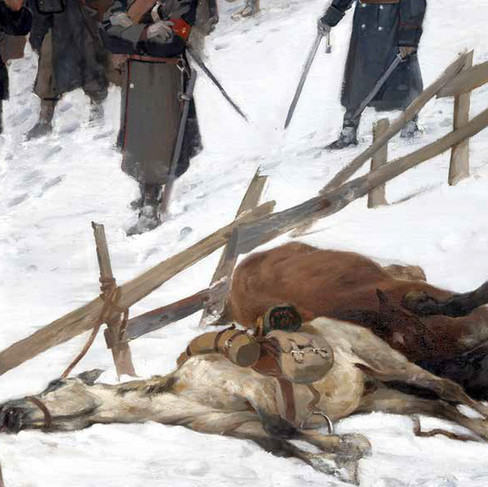


The French army brought 12,000 horses with them, and caring for the animals was a logistical nightmare in the dead of winter. Oats and hay were scarce, and many horses died before crossing the border. Soldiers were sometimes seen carving meat from the carcasses for food. Dead, dying, and emaciated horses appear throughout the panorama.
Unable to provide for them, the Swiss government eventually auctioned many off, and soldiers sold others privately (and illegally). Crossbreeding between French Arabians and local Jura horses left a genetic legacy that can still be seen in Switzerland today.
The Challenge of Transport

In another section, railway lines and an actual train carriage stand ready to move soldiers across Switzerland. At the time, railways in Switzerland were single-track, so all freight traffic had to be halted to carry the thousands of frostbitten men from the Jura Mountains to their temporary homes.
Role Models in Uniform

Swiss soldiers march in crisp formation, a stark contrast to the ragged and exhausted French. They stand as a symbol of Swiss discipline, neutrality, and readiness to help those in need.
Aftermath and Memory

Despite Swiss efforts, about 1,700 soldiers died from disease and injuries sustained during their retreat. Across Switzerland today, there are dozens of memorials to these men. One example is located just down the street from the Bourbaki Cyclorama in the cemetery of Lucerne’s Hofkirche (palace chapel).
But perhaps the most powerful testament comes not from a Swiss citizen, but from a French soldier, Émile Bellenger. Suffering from frostbite, he wrote:
"Switzerland is truly a paradise for the sick. What a welcome, what care we have received."
More Than a Painting
The Bourbaki Panorama is more than an art installation – it is an immersive historical record of a time when neutrality meant not just staying out of a war, but actively caring for its victims.
Unlike other cycloramas of the era, which celebrated destruction, this one celebrates humanity. If you cannot visit Lucerne in person, click below to watch a free virtual tour. Step inside, and like those who stood here in 1881 when it opened, you are surrounded not by the roar of battle, but by the quiet heroism of a country that opened its arms to strangers in need.
Sources
All information can be found on the Bourbaki Panorama Museum Website.
In addition, this very detailed source from the museum website shows exactly how many soldiers were housed in every Swiss town, and the specific location of every memorial to Bourbaki Army soldiers throughout Switzerland.


Comments